

Glass railings and salt-air corrosion: the real story
You will hear a lot of confident-sounding statements about salt-air corrosion when you shop for a glass railing in Jamaica. Some are true. Some are partly true. Some are flat wrong. Here is what actually happens to a glass railing on a Jamaican coastal home, why some installs fail in 18 months while others run 15 years, and where the real gap is between marketing claims and metallurgy.
What salt-air corrosion actually is
Salt-air corrosion is not really “salt” attacking metal directly. It is chloride ions, carried in microscopic salt aerosol particles, finding their way through the chromium oxide passive layer that protects stainless steel.
The mechanism in a few steps. Airborne sodium chloride particles settle on the hardware surface. Humidity (always high in coastal Jamaica) dissolves the salt, creating a concentrated chloride solution sitting on the metal. Chloride ions punch through the passive layer at any weak spot: a scratch, a deposit, a crevice. Once through, they create a self-sustaining acidic pocket that eats into the metal. The pit grows downward and inward, often invisibly from the surface, until structural failure.
That is the actual process. Not magic, not mysterious, entirely predictable. Which is exactly why spec choices matter so much.
The 304 vs 316 difference, explained for normal people
The endless 304-versus-316 argument comes down to a single alloy difference: 316 stainless contains 2 to 3 percent molybdenum that 304 does not.
Molybdenum changes the passive layer chemistry to make it much harder for chloride ions to break through. In standardised corrosion testing, 316 holds up to chloride attack roughly 3 times longer than 304. In real-world Jamaican coastal conditions the difference is comparable: 304 hardware shows visible pitting and tea-staining within 2 to 5 years, while 316 hardware stays clean for 10 to 15 years before serious corrosion appears.
That’s the entire story. No installer is going to tell you a special-grade 304 will perform like 316. It will not. The metallurgy is the metallurgy.
Tea-staining: what it is and what it isn’t
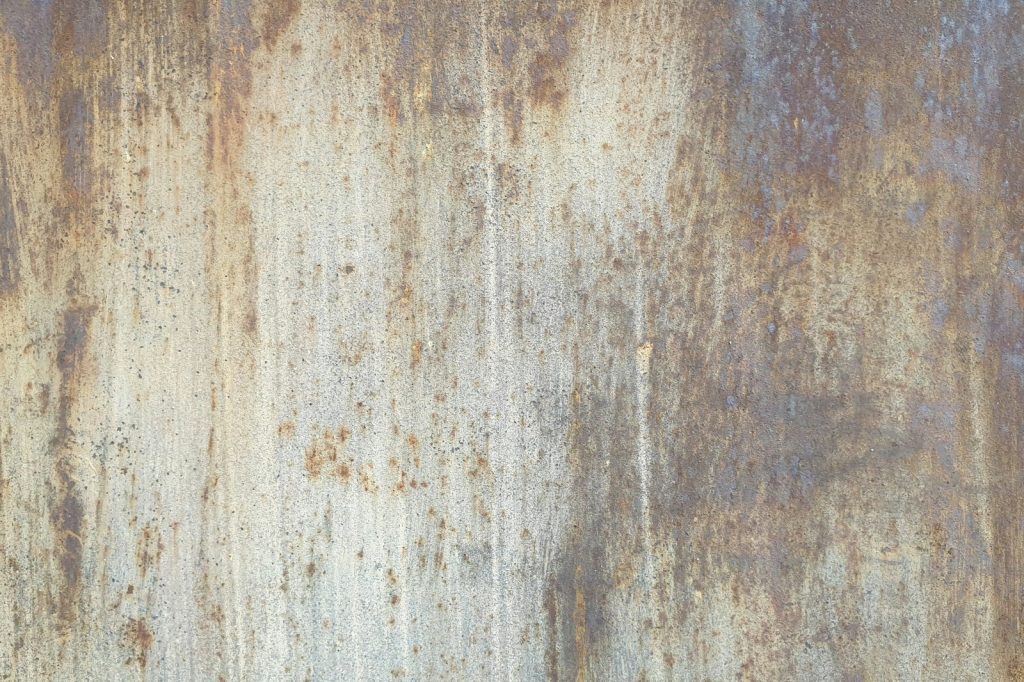
Tea-staining is the brown surface discoloration you sometimes see on stainless hardware. It is the first visible sign of chloride attack, and it looks alarming, but it is rarely an immediate structural problem.
What it actually is. Iron oxide deposits left on the metal surface as the passive layer starts to break down. Mostly cosmetic at the early stage; the metal beneath is still largely intact.
What it means for the hardware. The passive layer has been compromised somewhere, but the structural integrity is mostly preserved. With prompt cleaning and a passivation refresh, the hardware can be restored to near-original condition. Left untreated, tea-staining progresses to actual pitting within 6 to 18 months, and at that point the damage becomes structural and irreversible.
What it does not mean. Tea-staining is not “the railing is failing right now.” It is “the railing will fail if I do nothing.” There is a real window to fix it without replacing anything.
Where corrosion actually starts on a glass railing
Not all hardware surfaces fail at the same rate. The concentration points are predictable.
Crevices and joints. Anywhere two metal surfaces meet (a bolt threaded into a fitting, a washer pressing against a base plate) creates a crevice that traps moisture and concentrates chloride. Corrosion typically starts here first, even on 316 hardware.
Drilled and cut surfaces. The chromium oxide passive layer protects the original surface of the steel, not the inside of a hole that was drilled on-site. Every install creates fresh metal exposure that needs passivation to restore protection.
Undersides and bottom faces. Salt deposits accumulate on undersides because rain does not rinse them off. The undersides of brackets, spigot bases, and fastener heads are often the first places to show tea-staining.
Welded joints. Welding alters the chemistry of the metal around the weld, leaving a heat-affected zone that is more susceptible to corrosion. Quality glass railing systems use mechanical fasteners rather than welds wherever possible, for exactly this reason.
Knowing where corrosion starts means knowing where to focus maintenance. The inspection priority is not the visible front face of the hardware; it is the joints, undersides, and any drilled or cut surfaces.
Why on-site passivation matters so much
Brand-new 316 stainless hardware arrives at the site with a factory-grade chromium oxide passive layer. During installation, that layer gets damaged. Drilling creates exposed fresh metal inside the hole. Cutting creates exposed metal on the new surface. Scratching from tools and handling creates micro-breaches across the visible surfaces.
Without restoration, those damage points become corrosion initiation sites within weeks. On-site passivation with a citric acid solution (per ASTM A967) chemically restores the passive layer across the entire hardware surface after installation, sealing the install damage and giving the hardware its full design life.
How much difference does it actually make? In our post-install inspection data on Jamaican coastal sites, passivated installs show 60 to 80 percent less tea-staining at the 24-month mark compared to identical installs without passivation. It is the single most underrated step in coastal glass railing work.
Common myths and what is actually true
A few statements you will hear and what the actual story is.
“Marine-grade stainless never rusts.” False. Even 316 will eventually show tea-staining and pitting in heavy salt environments. It just takes much longer. “Never rusts” is marketing language, not metallurgy.
“You can use 304 if you just clean it more often.” Partly true but expensive. Aggressive cleaning can extend 304 life on a coastal install from 2 to 5 years to maybe 4 to 7. Still less than half what 316 gives you, and the labour cost of the aggressive cleaning schedule typically exceeds the 30 percent hardware premium for 316 within 18 months.
“Painted or coated steel is just as good as stainless.” False for structural railing hardware. Paint and coatings have finite life (typically 3 to 8 years on coastal sites), and once the coating fails the steel underneath corrodes much faster than bare stainless ever would. Coatings on structural steel are a temporary fix, not a structural solution.
“All 316 is the same.” Not quite. There is regular 316, low-carbon 316L, and various derivatives. For most railing applications the differences are small and standard 316 is fine. For welded joints specifically, 316L is meaningfully better because it resists the chromium depletion that happens at weld heat-affected zones.
“Salt doesn’t reach here, we’re a mile from the beach.” Maybe true, maybe not. Salt aerosol travels significantly further than people expect, especially during sustained trade winds. The reliable test is the salty taste at the front door, not GPS distance to the water.
What the right spec actually looks like
For a Jamaican coastal glass railing built to survive salt-air corrosion as long as the design allows:
316 stainless steel for every metal component, including bolts, washers, anchor hardware embedded in concrete, and any spacer or bracket. Match grade across the entire assembly; mismatch creates galvanic cells that accelerate corrosion at the interfaces.
On-site passivation with citric acid solution (ASTM A967) after all hardware is installed, before final commissioning.
Marine-grade structural silicone (Dow Corning 995 or equivalent) at all glass-to-hardware interfaces. Generic silicone degrades under combined UV and salt exposure within 2 to 4 years.
Aluminum components in AAMA 2605 powder coat, not AAMA 2603 or 2604. The higher grade resists salt-driven coating degradation.
Annual maintenance program with quarterly fresh-water rinses, semi-annual deep cleaning, and annual passivation refresh on any tea-stained hardware.
Properly executed, this spec gives 10 to 15 years of structural integrity in coastal Jamaican conditions before any significant intervention is needed.
A short summary
Salt-air corrosion on glass railing hardware is not magic; it is chloride ions punching through the protective passive layer on stainless steel. 316 stainless resists this attack roughly 3 times longer than 304 because of its molybdenum content. Tea-staining is the early warning sign and is reversible if addressed promptly. Left untreated it progresses to structural pitting within 6 to 18 months. On-site passivation after install is the most underrated step in coastal glass railing work and the single biggest factor in long-term hardware durability beyond grade selection itself. Get the spec right and the railing runs 15-plus years on the Jamaican coast. Get any of it wrong and the failure timeline shrinks dramatically.
Related reading
- Glass railings in coastal Jamaican homes
- How long do glass railings last in coastal Jamaican homes?
- Why glass railings fail and how to prevent it
For background on the metallurgy of stainless steel and chloride corrosion, see the Wikipedia entry on pitting corrosion.
The next step
If you are weighing hardware spec for a Jamaican coastal glass railing and want input on the real cost-versus-life trade-offs for your specific exposure, our team is happy to walk you through the options. Honest input on what your particular site actually needs to make the railing last as long as the design allows.
Request a hardware-spec consultation, browse our work, or get a quote on a new install to start.