


Shower enclosures for retail spaces in Jamaica
Most of the shower work we get asked about is residential. But about one in eight enquiries comes from a retail business. A gym off Constant Spring Road wanting to add member showers. A salon in Mandeville fitting out a back-of-house staff bathroom. A wellness studio in Kingston putting in a steam shower for clients. A small hotel tied to a beachside restaurant. The briefs look similar on the surface and behave nothing like a home install in practice.
If you are planning a shower enclosure for a retail or commercial space in Jamaica, here is what changes from a residential job and how we handle it.
Use case decides almost everything
Before glass thickness, before hardware, before the door swing, the first question is who uses the shower and how often.
A staff-only bathroom in a small retail unit might see four uses a day. Short shower, the door opens and closes maybe twenty times a week. In wear terms that is closer to a home install. You can use residential glass and hardware specs and the enclosure will hold for fifteen years.
A members-only gym shower behaves nothing like that. Twelve uses a day per stall. Peak crowding around six in the evening and again Saturday mornings. Hard handle pulls from people in a hurry. The occasional duffel-bag swing into the glass. That install needs hospitality-grade hinges, a thicker glass spec, and a seal system that survives daily commercial cleaning. The mid-range residential kit will fail within two years.
A spa or wellness suite sits in between. Lower volume than a gym, more attention to look and feel, often with steam and aromatherapy involved, which changes what the seals have to tolerate.
So when we quote a retail job, the first conversation is about traffic and use pattern. Those numbers shape every other decision.
Glass thickness goes up
In a home, three eighths of an inch tempered glass is the standard for frameless enclosures. It looks clean, it is rigid enough for typical door spans, and it is the right cost-quality balance for residential use.
In commercial retail, we usually move up to half-inch tempered glass on the door panel and any panel that gets touched. The extra weight makes the door feel solid in heavy use. It tolerates impact better. And a gym member who pays an annual fee notices when the door wobbles. They also notice when it does not.
For fixed panels nobody touches, three eighths is still acceptable. For partition walls between stalls in a multi-stall shower room, we sometimes go to half-inch with a satin or frosted finish for privacy.
Hardware is the bigger spend than at home
Residential hinges are rated for tens of thousands of cycles. Commercial hospitality hinges are rated for hundreds of thousands. The price gap is real, sometimes triple what the same-looking residential part costs. The longevity gap is real too. A residential hinge in a gym shower will be sloppy in eighteen months. A hospitality-rated hinge will be tight at year ten.
A few things to look for on the spec sheet. The hinge maker should publish a cycle rating, not just a finish description. Pivot bushings should be replaceable rather than sealed. The mounting plate should be heavy gauge. Door pulls should be through-bolted, not surface-bonded, because in a busy retail bathroom the pulls take a hard daily beating.
In coastal locations, layer the marine grade question on top. Even an inland retail space half a mile from the water needs 316 stainless for the load-bearing parts. Salt does not know it is in a gym instead of a beach house.
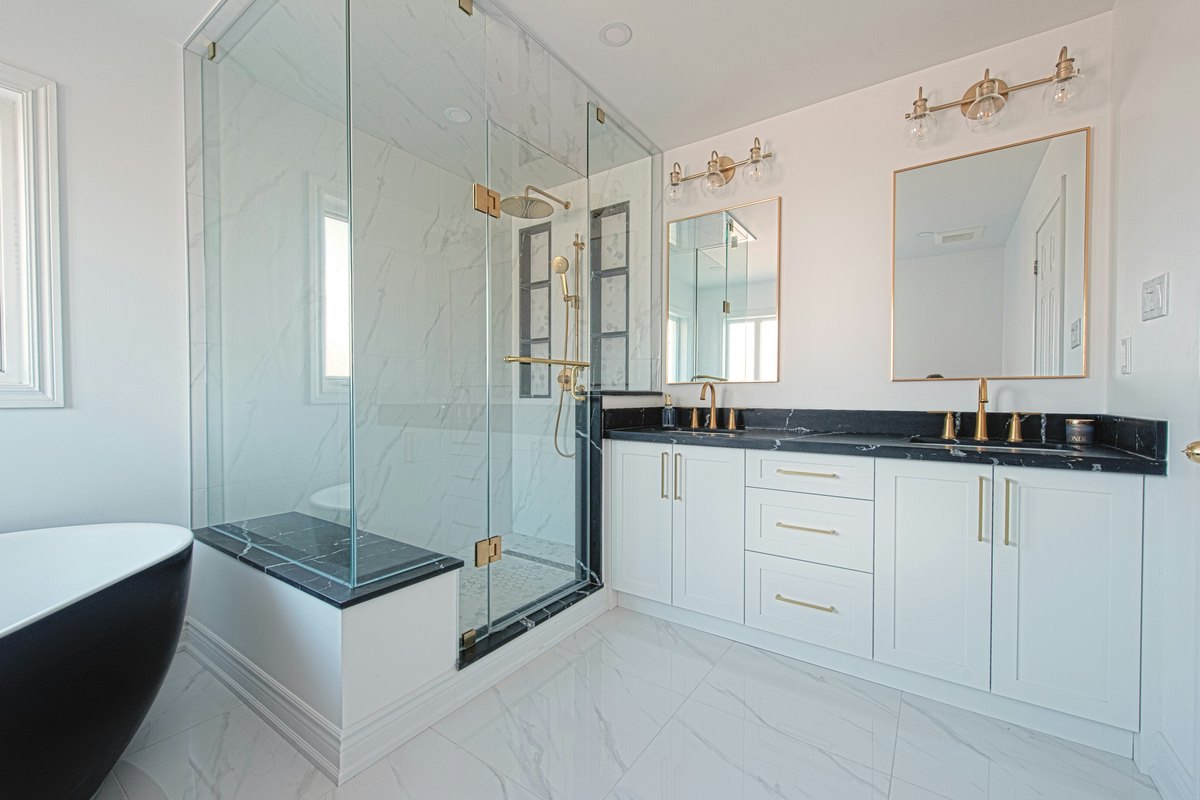
Drainage and floor build matter twice as much
Most of the residential shower failures we see are slow leaks at the bottom of the panel where it meets the floor or tray. In a home, a slow leak shows up as a stain over months and gets caught at the next deep clean. In a busy retail bathroom, the same slow leak goes from invisible to puddle in days because the volume of water moving through is so much higher.
For commercial fits, we usually spec a linear drain across the entry edge rather than a centre drain, because it handles peak-hour multi-user volume without backing up. The floor needs to slope towards the drain at a quarter inch per foot, not the residential one eighth, because the higher use rate creates more standing water on a shallower slope. And the waterproof membrane should extend six inches up the wall behind the tile, not the residential three inches, because splash height is greater under commercial use.
Get the floor right and the enclosure has a chance of lasting. Get it wrong and the best frameless system on the island will still let water creep into the slab.
Codes, accessibility, and the parts homeowners do not think about
Jamaican commercial fit-outs need to meet the National Building Code as adopted, which includes accessibility provisions for public-facing spaces. For a gym or spa that takes paying members, at least one shower needs to be wheelchair accessible. That usually means a curbless entry, a clear interior of at least 36 inches by 60 inches, a fold-down bench, grab bars, and a hand-held shower head on a slide bar.
For the glass enclosure on an accessible stall, you want a wide swing-out door or a curtain rather than an inward swing, so an attendant or first responder can reach the user if needed. The door should clear at least 32 inches when open. Glass edges that face the open user area need polished edges, not just blunted, so a gripping hand does not get hurt.
If the bathroom is staff-only, accessed only by employees of the business, the accessibility requirements are lighter. But you should still talk to the architect or the parish council about what is required for your specific permit class.
Cleaning regime and seal life
In a home, a weekly squeegee plus a monthly proper clean is normal. In a retail space, cleaning happens daily, often with stronger products than the average homeowner uses, and the seals take that beating. After about two years of daily commercial cleaning, the door sweep and side wipe seals start to deform. They lose their grip on the glass and a thin water trail starts running out under the door.
Plan for a seal swap in your operating budget. It is a small job, maybe fifteen minutes per door for a competent tech, and the parts cost very little. We include a seal-swap reminder in our handover pack for commercial clients. The cost of letting seals go is water on the floor outside the enclosure and, eventually, a slip claim from a member who did not see it.
The other big cleaning topic is the product. Stay away from chlorine bleach and strong acid descalers on the metalwork. They eat the protective layer on the alloy and shorten hardware life. A neutral-pH bathroom cleaner with a soft cloth handles 95 percent of what a retail bathroom needs. Save the heavy stuff for the floor and the tile only.
Downtime planning
This is the one thing residential clients rarely think about and retail clients always do. The shower has to come out of service for the install. For a single-stall staff bathroom, that is half a day and nobody notices. For a multi-stall gym shower room, taking the whole bank out of service during peak member hours is a customer-experience problem and can cost you cancellations.
For larger commercial jobs, we phase the install. Half the stalls one week, the other half the following week, so members always have working showers. We can also do most of the off-site fabrication in advance, then schedule the on-site fitting for overnight or early-morning windows when the space is closed. It costs a bit more in coordination but it saves the operating disruption.
What to put in the brief when you call us
If you are about to ask any installer for a commercial shower quote, ours included, here is what makes the quote accurate rather than a wide guess.
Use type: staff, members, customers, mixed. Traffic estimate, in daily uses per stall. Location, especially whether you are within two miles of the coast. Whether you need any accessible stalls and how many. Your cleaning regime, including the products your janitorial service uses. Your downtime tolerance, including whether overnight or weekend install is possible.
With those six things we can quote tightly and explain in plain English what spec we are recommending and why. Without them, every retail quote is a best guess that often misses the real cost by 20 to 30 percent in either direction.
Related reading
- Choosing shower enclosure hardware that lasts longer than five years on the coast
- Shower enclosures and salt-air corrosion: the real story
- Parish-specific advice for shower enclosures
For the basics on commercial-grade glazing and how it differs from residential, see the Wikipedia article on tempered glass.
The next step
If you are planning a shower install in a gym, spa, salon, hotel, or any other retail or commercial space in Jamaica, our team handles the full commercial brief from site visit through phased install to handover documentation. We spec hospitality-grade hardware, name the alloy in writing, and back the workmanship with a one-year warranty.
Request a commercial quote, browse our shower enclosure work, or get in touch to talk through your space before you commit to a spec.