

Smart shower enclosures: are they ready for everyday use?
Every few months a homeowner asks us about smart shower enclosures. The kind with switchable privacy glass, app-controlled doors, integrated displays, voice-activated mixers. The brochures look impressive. The price tags are real. The question we always get is, “would you put this in your own bathroom?”
The honest answer depends on which piece of smart tech we are talking about. Some of it is genuinely ready for everyday Jamaican use. Some of it is fine in a showroom and frustrating at six in the morning when you are trying to get to work. Here is our breakdown.
What “smart shower enclosure” actually means
The term gets used to bundle several distinct technologies together in marketing.
There is switchable privacy glass that goes from clear to opaque with a switch or app command. Mature technology, reasonably reliable.
There are digital and smart mixers that let you preset temperature, flow rate, and shower timing. Some are wall-controlled, some are app-controlled, some are voice-controlled.
There are integrated displays in the shower stall, showing time, weather, music controls, or other information.
There are app-controlled door latches and hinges that lock or unlock based on phone proximity or a code.
And there is steam and aromatherapy integration, with programmable cycles.
Each of these has a different maturity level, different failure modes, and a different answer to the “everyday use” question.
What works well today
Switchable privacy glass is the most mature of the bunch. It has been used in commercial settings (conference rooms, hospitals, hotels) for over a decade and the technology has settled. In a residential bathroom it works reliably as long as the install respects a few rules. The wiring is done by a qualified electrician. The switch is mounted outside the wet zone. The power supply is on a dedicated circuit. Failures are rare, and when they happen, the glass usually fails in the opaque mode (which is the safer default) rather than catastrophically.
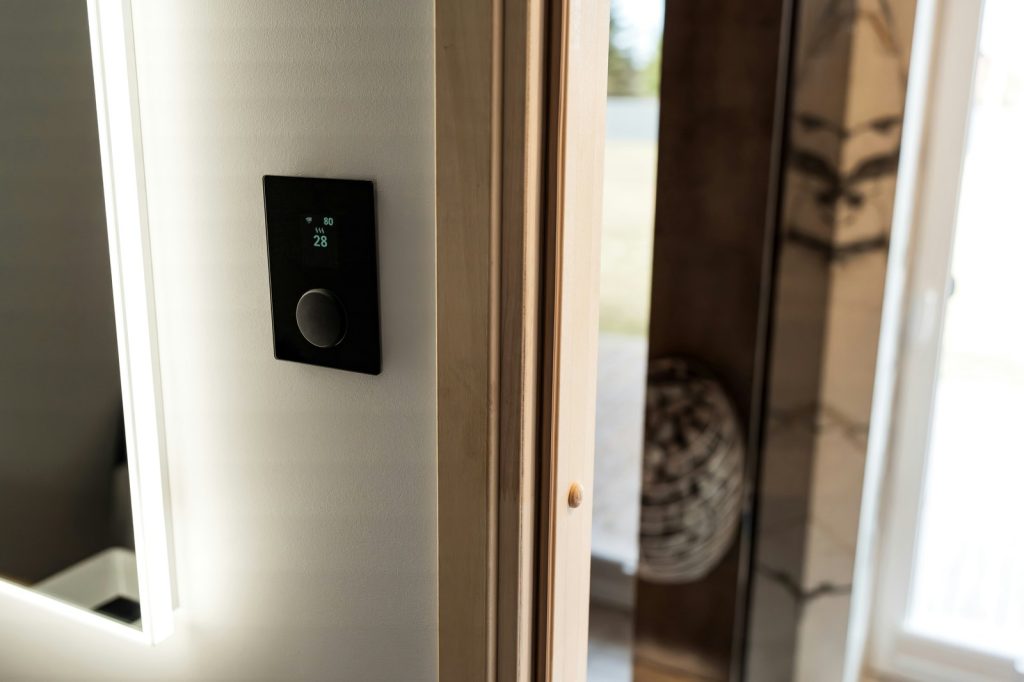
Digital wall-mounted mixers with simple preset buttons are also good. The technology is essentially a programmable thermostatic valve with a digital interface. No app, no internet, just a panel that saves a preferred temperature and flow rate for each user. We have installed several of these and they hold up well in Jamaican conditions, provided the build quality is decent.
Steam and aromatherapy systems work too, with the caveat that they need real ventilation in the bathroom to clear the moisture between cycles. In a small en-suite without dedicated extraction, the steam build-up becomes a mould problem within a year. With proper venting, they perform fine.
What is still iffy
App-controlled fixtures are the category where most of the bad reviews land. The problem is not the hardware. It is the dependency stack. The app talks to the cloud. The cloud talks to a controller. The controller talks to the valve. Any link in that chain breaking takes the shower offline. Power outage during a storm and the app loses connection. App update goes wrong and the shower will not start. Wifi router replaced and the system needs to be reconfigured.
We have heard from enough owners of app-controlled shower mixers in the past two years to be cautious. The “smart” in the marketing often translates to “extra failure modes” in practice. If you want the precision of a thermostatic mixer, get one with manual controls. The reliability is dramatically better and the temperature performance is the same.
Voice control has the same problems plus one of its own. If you are in the shower, ambient water noise makes voice recognition unreliable. The first time a homeowner shouts “stop” three times at a smart shower while soaped up is usually the last time they use the voice feature.
Integrated displays inside the shower stall are interesting in showrooms and inconvenient in real bathrooms. The screen is a sealed electronic in a humid environment. It has a real lifespan, probably five to seven years before condensation gets to it. When it fails, the wall has to come down to replace it. We rarely recommend these for residential use.
App-controlled door latches we do not recommend at all. A wet bathroom door is the wrong place for an electronic lock. The failure mode of “door will not open” is genuinely dangerous, especially with children or elderly users.
The Jamaican angle
Two things make Jamaica a slightly tougher environment for smart bathroom tech than the US or European markets where these products are designed.
Power reliability. JPS has gotten more reliable in the past five years, but outages still happen, especially during storm season. Anything that needs continuous power to function correctly (switchable glass in the clear state, certain app-controlled fixtures) reverts to a default state during an outage. Plan for what that default is and whether it is acceptable.
Internet reliability. Home Wifi in Jamaica is good in the cities and patchy elsewhere. Anything that depends on a cloud connection has the same patchy experience as your streaming services. If your internet drops twice a week, your app-controlled shower drops twice a week.
Both of these argue for keeping smart tech in the shower local rather than cloud-dependent. A wall switch on switchable glass is more reliable than an app. A thermostatic mixer with physical presets is more reliable than an app-controlled one. A timer for steam is more reliable than a scheduled program.
Our practical recommendation
If you want smart features in your shower today and you want them to still be working in five years, here is what we would actually install.
Switchable privacy glass, yes, with a wall switch and a dedicated circuit. Worth it for the right layout.
A high-quality thermostatic mixer with digital presets but local controls, not app-based. The temperature precision is the real benefit and you get it without the connectivity risk.
A simple electric steam generator with a timer if you want steam, vented properly, with manual controls.
Skip the app-controlled fixtures, the in-stall displays, the voice controls, and the electronic door latches. They are not bad ideas. They are just not mature enough for daily-use installs in Jamaica yet. Maybe in five years.
The line we draw is whether the smart feature improves the shower or adds new ways for the shower to go wrong. Switchable glass and a good thermostatic mixer pass that test. Most of the rest does not.
Related reading
- New developments in shower enclosure technology worth knowing
- Eco-friendly shower enclosures: what is real and what is marketing
- Choosing shower enclosure hardware that lasts longer than five years on the coast
For background on the switchable glass technology underpinning smart privacy panels, see the Wikipedia entry on smart glass.
The next step
If you want a shower install that incorporates the smart features that actually work day-to-day in Jamaican conditions, and skips the ones that will frustrate you in five years, our team can spec a build that uses mature tech where it earns its keep and stays conventional where it does not.
Request a quote, browse our shower enclosure work, or get in touch to talk through what makes sense for your bathroom.