

Storefronts and salt-air corrosion: the real story
If you have ever wondered why coastal Jamaican storefronts cost so much more to spec properly than inland ones, and why installers in Negril or Treasure Beach get pedantic about hardware grades, the answer is in the chemistry of what salt air does to aluminum and steel.
This is the real story. What happens, why it happens, and what spec choices actually extend the working life of a coastal storefront in Jamaica.
What salt air actually is
“Salt air” is a slightly misleading phrase. The salt is not floating around as gas. What is happening is that breaking surf throws tiny droplets of seawater into the atmosphere, the water evaporates, and the dissolved salt (sodium chloride, with smaller amounts of magnesium and calcium chlorides) is left as microscopic crystals suspended in the air or settled on surfaces.
These crystals can travel surprising distances. Heavy salt deposition is measurable at least 1 kilometre from breaking surf on Jamaica’s exposed coasts (Negril, Treasure Beach, Portland). Lighter deposition is measurable up to 5 kilometres inland on windy days.
When salt crystals settle on a surface, they sit there inertly until water lands on them. Then they dissolve back into salt water, and that is when the corrosion chemistry starts. Coastal Jamaica combines frequent salt deposition with humidity in the 80 to 95 percent range, which means surfaces stay wet with salt solution for significant portions of every day.
Why aluminum is supposed to be corrosion-resistant
Aluminum looks like it should be corrosion-prone because it is so reactive (in pure chemistry terms, aluminum oxidises more easily than iron). But aluminum exposed to oxygen instantly forms a thin layer of aluminum oxide on the surface, typically 4 to 10 nanometres thick.
That oxide layer is hard, transparent, electrically insulating, and chemically stable. It protects the aluminum underneath from further oxidation. As long as it stays intact, the aluminum effectively becomes corrosion-resistant.
This is why aluminum cookware does not rust, why aluminum bicycle frames last decades, and why aluminum window frames hold up well in most environments. The oxide layer does its job.
The problem coastal is that chloride ions can punch through it.
How chloride breaks the protective layer
Salt water is a chloride solution. When chloride ions in solution contact the aluminum oxide layer, they migrate through microscopic defects and pores in the oxide and reach the metal underneath.
Once a chloride ion contacts bare aluminum, it forms aluminum chloride at that specific spot. Aluminum chloride is water-soluble (unlike aluminum oxide), so it dissolves into the surrounding moisture, exposing fresh metal. More chloride attacks the fresh metal. The cycle continues.
The result is pitting corrosion. A microscopic hole forms in the surface, then deepens and widens over time, while the surrounding surface remains apparently intact. From the outside, you see a tiny dark spot. Inside the metal, the pit is propagating downward.
This is why coastal aluminum often looks fine on cursory inspection but is structurally compromised. The damage is invisible until it is severe.
The autocatalytic acceleration
Once a pit forms, the chemistry inside it makes things worse.
The pit creates a small enclosed environment where dissolved oxygen is depleted (because the pit interior is shielded from atmospheric oxygen). That shifts the chemistry inside the pit. The aluminum chloride solution becomes acidic (pH dropping to 3 or 4, versus the neutral 7 of the surrounding air). The acidic environment accelerates further dissolution.
The pit also concentrates moisture. Aluminum chloride is hygroscopic, which means it actively pulls water out of the surrounding humidity. So a pit on the surface of an aluminum frame in coastal humidity has a permanently wet, acidic, chloride-rich environment inside it, even when the rest of the surface is dry.
This is autocatalytic corrosion. The pit creates conditions that make the pit grow faster, which creates more aggressive conditions, which accelerates further. Once started, it does not stop until the metal is consumed at that point or the chloride source is removed and the pit is treated.
What this means for storefront aluminum
Standard mill-finish aluminum in coastal conditions starts showing pitting within 12 to 24 months. The pitting is visible as small dark spots on the surface, often with a white powder (aluminum oxide and hydroxide) around them. By year five, the pitting is significant and the aluminum has lost both structural integrity and visual cleanliness.
Powder-coated aluminum lasts longer because the coating shields the aluminum from chloride contact. But the coating is only as good as its weakest point. Any scratch, chip, or porosity in the coating becomes a starting point for pitting underneath, and the corrosion then propagates under the intact coating where you cannot see it.
AAMA 2603 powder-coat (the lowest commercial grade) typically fails coastal in 3 to 5 years. AAMA 2604 lasts 7 to 12 years. AAMA 2605 with 70 percent PVDF resin lasts 15 to 25 years and is the only powder-coat genuinely suitable for direct coastal exposure.
Anodised aluminum is the strongest defense of all. Anodising electrochemically thickens the natural oxide layer from a few nanometres to 10 to 25 micrometres, making the protective layer much more robust against chloride penetration. Anodised aluminum in coastal conditions lasts 25 to 40 years before significant pitting becomes a problem.
What this means for storefront hardware
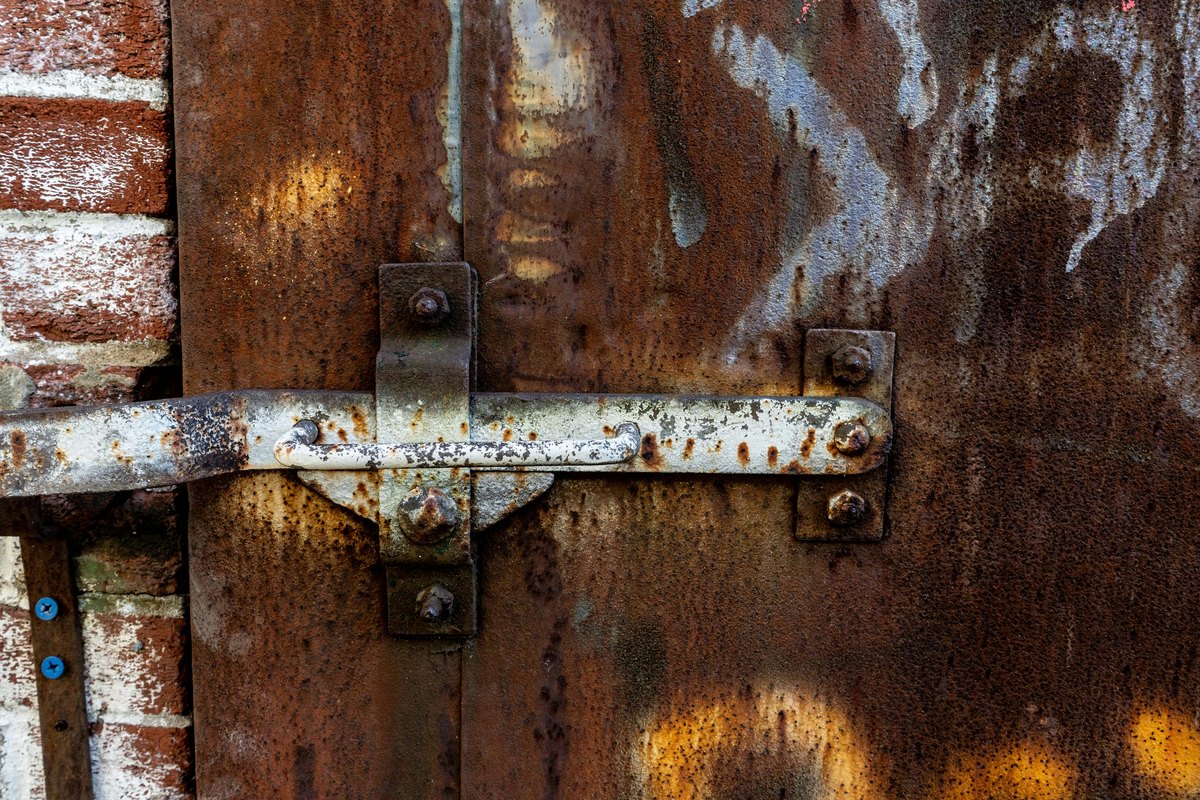
Steel rusts in salt air. This is not news. What is less obvious is the timeline.
Standard zinc-plated steel hardware (common on low-cost commercial work) starts showing visible rust within 6 to 18 months coastal. Within 3 years it is structurally compromised.
Chrome-plated steel lasts longer (the chrome shields the steel) but the same logic as powder-coat applies. Any scratch or porosity in the chrome becomes a starting point. Coastal chrome typically fails in 3 to 7 years.
Standard 304 stainless steel is much better. Chromium in the steel forms a passive chromium oxide layer that resists chloride attack. But 304 stainless does still pit in heavy coastal exposure, just much more slowly. Coastal 304 lasts 8 to 15 years before showing significant pitting.
316 stainless steel adds 2 to 3 percent molybdenum to the alloy, which significantly increases pitting resistance. 316 in coastal conditions lasts 20 to 40 years with minimal visible corrosion. For Jamaican coastal work, 316 is the only acceptable grade for hardware that touches air.
What this means for fasteners and hidden anchors
The hidden anchors and concealed fasteners in a coastal storefront install are often where the worst damage happens, and where it goes undetected longest.
If the hidden anchors are zinc-plated steel (as they often are on lower-cost installs), they corrode at the same rate as visible zinc-plated steel. The frame looks fine on the surface, but the anchors holding it to the structure are progressively weakening. The first sign of failure is often the frame starting to shift in the opening, which signals that the anchors have lost most of their structural capacity.
Galvanic corrosion makes this worse. When two different metals are in electrical contact in the presence of an electrolyte (salt water), the more active metal corrodes faster than it would alone. Standard steel anchors in contact with aluminum framing in salt-water exposure corrode much faster than the same steel would in isolation, because the aluminum acts as a sacrificial anode and accelerates the steel corrosion through the connection.
The fix is to use 316 stainless for all hidden anchors and to isolate the anchor from the aluminum with a non-conductive sealant or sleeve where they meet. Standard practice on quality coastal installs. Rarely done on cost-cut installs.
The realistic coastal lifespan picture
For a Jamaican coastal storefront, the realistic lifespan depends entirely on spec.
Bottom-of-market install with mill-finish or AAMA 2603 aluminum, zinc-plated steel hardware, and standard sealants gets 5 to 8 years before significant visible failure and 8 to 12 years before structural concerns. When it fails, it usually means full replacement.
Mid-market install with AAMA 2604 aluminum, 304 stainless visible hardware, and mixed sealants gets 10 to 15 years before significant maintenance and 15 to 20 years before replacement. Partial refurbishment at year 15 typically costs around 30 to 50 percent of the original install.
Quality coastal install with AAMA 2605 or anodised aluminum, 316 stainless throughout, marine-grade sealants, and engineered drainage gets 25 to 40 years with regular maintenance. Refurbishment at year 20 or 25 typically costs around 20 to 30 percent of the original install, with full replacement deferred to year 40 or beyond.
The cost difference between the bottom and top spec is roughly 40 to 70 percent at install time. The cost difference over a 25-year property lifespan is dramatic, and the top spec wins.
What maintenance actually does for coastal aluminum
Even on properly specced coastal storefronts, maintenance significantly extends the lifespan.
Quarterly fresh-water rinsing physically removes salt crystals before they can accumulate to corrosive concentrations. This alone extends the working life of the install by 5 to 10 years over an unmaintained equivalent.
Annual sealant inspection and touch-up prevents water ingress that would otherwise create concentrated corrosion zones behind the frame.
Annual hardware inspection catches early-stage pitting on stainless components before it becomes structural.
Every three to five years, professional cleaning with mild acid treatment removes any salt deposits that have accumulated despite rinsing and re-passivates any stainless components that have started to show surface pitting.
The maintenance cost over a 25-year lifespan is typically 10 to 20 percent of the original install cost. The lifespan extension from that maintenance is roughly 50 to 100 percent. Easily the best-value spend in the coastal storefront budget.
A simple closing thought
The reason quality coastal storefront installers charge significantly more than non-specialists is not markup. It is the cost of the AAMA 2605 aluminum (or anodised), the 316 stainless hardware, the engineered detailing, and the experience of knowing what fails and what does not.
You can absolutely save 30 to 50 percent on the upfront cost by using lower-spec materials and standard hardware. You will spend more than that doing the install over again in 7 to 10 years, plus the cost of operating without a functional storefront during the replacement, plus the cost of dealing with whatever damage the failing install caused to surrounding masonry and finishes.
For a Jamaican coastal property you plan to own for more than a decade, the only economical answer is to spec it properly the first time.
Related reading
- Storefronts in coastal Jamaican homes
- How long do storefronts last in coastal Jamaican homes?
- Parish-specific advice for storefronts
For background on the electrochemistry of aluminum corrosion, see the Wikipedia entry on pitting corrosion.
The next step
If you are planning a coastal storefront install or trying to assess whether your existing install is likely to give you another decade or fail next year, our team is happy to help. We can walk through proper spec for new installs, evaluate existing installs for early-stage corrosion that is still recoverable, and recommend maintenance schedules that extend lifespan substantially.
Request a coastal assessment, browse our coastal work, or get a quote to start.