

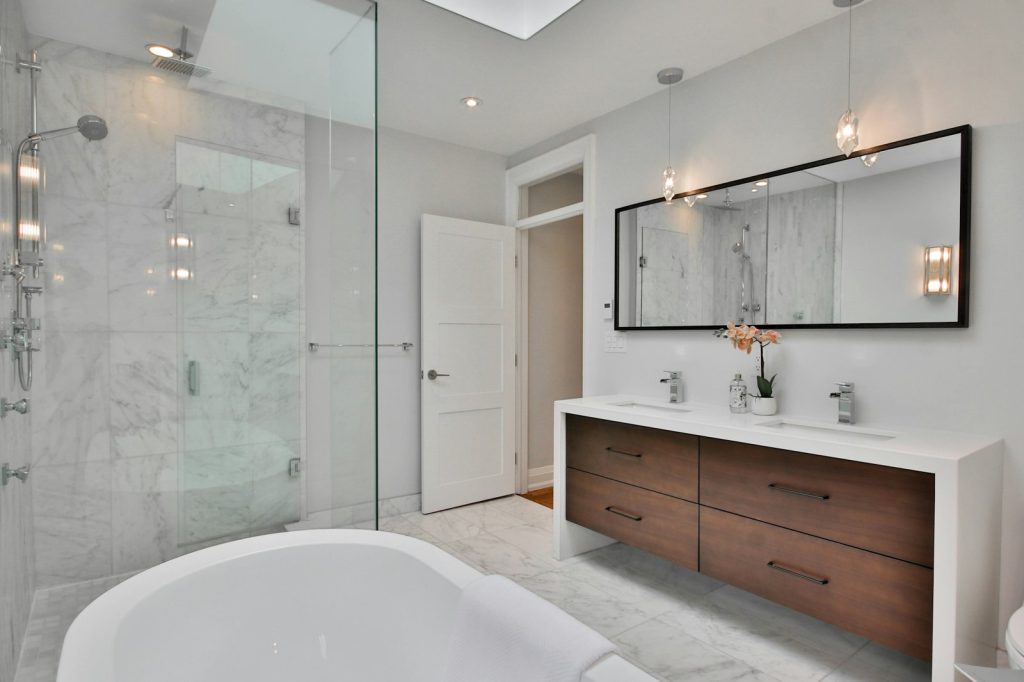
Almost every shower renovation we quote starts with the same question, in one form or another: frameless vs framed. The two look different from across the room, they cost different amounts, and they age differently in our climate. Both are good options. Neither is the right answer for every bathroom.
Here is the breakdown we walk through on site with first-time customers, in roughly the order it tends to come up.
Frameless vs framed shower enclosures: the structural difference
Both enclosures start with tempered safety glass panels. The difference is what holds those panels together.
A framed enclosure has aluminum extrusions running around every edge of every glass panel. The frame carries the load, seals the joints, and gives the door something to swing or slide against. The glass is usually thinner because it is not doing the structural work.
A frameless enclosure uses thicker glass panels held in place by small hinges, clamps, or U-channels bolted to the wall and floor. The glass itself is structural. There is no metal edging running around the perimeter.
A semi-frameless sits between the two. The fixed panels get minimal framing for support, but the door swings free without a frame around the moving panel.
That structural choice drives most of what follows.
How they look in the bathroom
The visual difference is the reason most clients reach out about frameless in the first place. With no metal lines around the edges, frameless reads as one continuous sheet of glass. Small bathrooms feel bigger because your eye does not stop at a frame. Tile and stone work behind the glass becomes the focal point, not the enclosure itself.
Framed enclosures look more conventional. The aluminum frame is visible and finished in one of the standard colours (chrome, brushed nickel, matte black, oil-rubbed bronze). The frame can be a feature in its own right when the rest of the bathroom hardware ties into the same finish. It can also feel busier than frameless if the bathroom already has a lot going on visually.
Frameless suits a minimalist or contemporary bathroom. Framed suits a traditional or transitional bathroom, or any bathroom where the budget is the priority and the look is not. Neither is dated. Both still get installed in new builds in Jamaica every week.
What each option actually costs
We keep the pricing vague on the website on purpose. The factors that drive it (glass thickness, hardware grade, panel layout, hinge count, custom angles) move the number more than the choice between framed and frameless does. The general pattern still holds though:
- A standard framed shower enclosure for a 60 inch alcove is the least expensive option we typically quote.
- A semi-frameless version of the same opening is moderately more.
- A fully frameless version of the same opening, with thicker glass and quality hinges, is the most expensive.
The cost gap is real but not huge for a standard opening. Where the gap widens is with custom geometry. A frameless corner enclosure with an inline panel and a swing door costs noticeably more than a framed version of the same layout, because the glass spec goes up and the hardware count goes up.
Get a written quote that breaks out the glass spec, hardware, and labour separately. The bottom line is less informative than the line items.
Glass thickness and safety
Framed enclosures usually run 3/16 or 1/4 inch clear or tinted tempered glass. The aluminum carries the structural load so the glass can be thinner. That is fine for performance and meets safety codes when the glass is properly tempered.
Frameless enclosures need thicker glass because the panel is doing the structural work. The two common options are 3/8 inch and 1/2 inch. Three-eighths of an inch is the standard frameless thickness and works for most home bathrooms. Half an inch is the upgrade for larger openings, taller panels, or any installation where the glass is unusually exposed.
Both are tempered. Both, if they ever do break, crumble into small blunt pieces rather than sharp shards. That is a safety code requirement, not an upsell.
A few homes ask for laminated panels in the shower as a further safety upgrade. Laminated stays in one piece if struck. It is more expensive and rarely required for residential showers, but worth knowing the option exists.
The thicker the glass, the more substantial the enclosure feels. That is partly aesthetic and partly real performance.
Hardware that does or does not exist
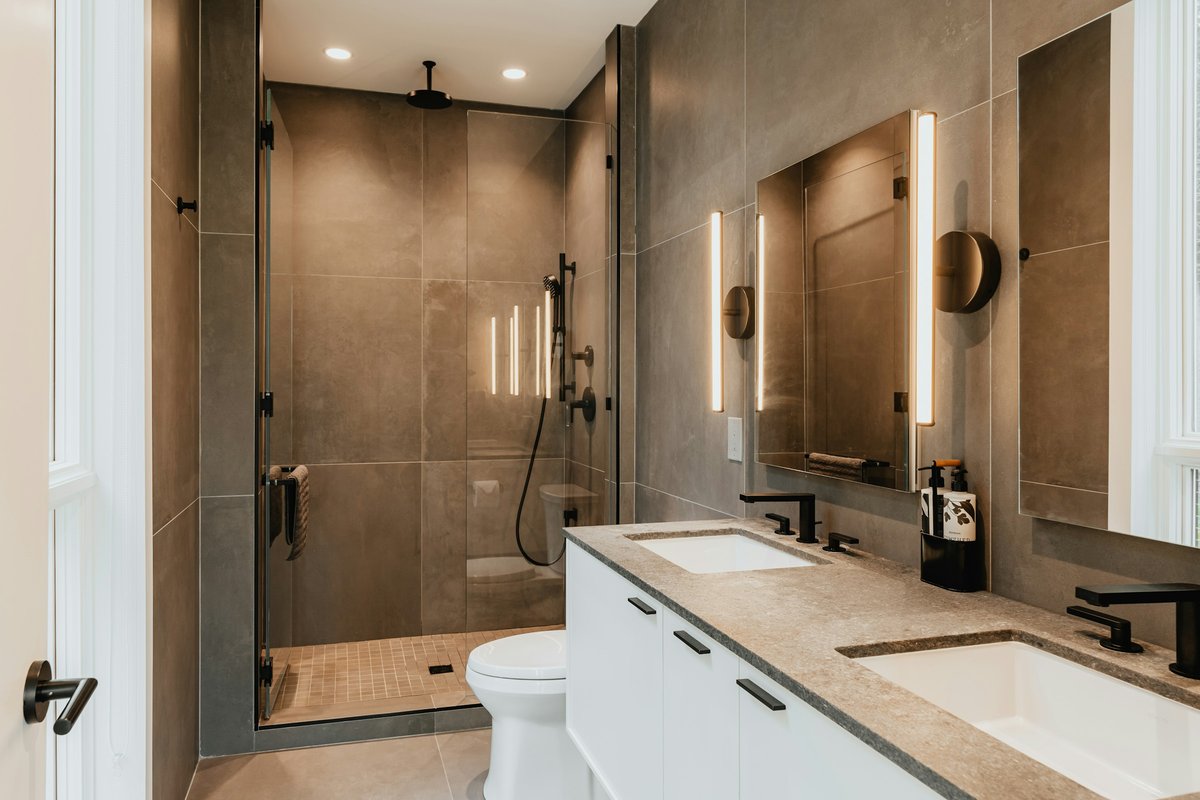
A framed enclosure has its hardware built in. The frame is the structure, the seals run along the inside of the frame, and the door hardware mounts to the frame. Replacing a worn part usually means a standard part from the same system.
A frameless enclosure depends on a smaller number of more expensive parts. Hinges have to carry the full weight of a 30 to 40kg glass panel and hold it square for years. Clamps and U-channels have to be aligned to the millimetre. Handles bolt through the glass itself.
This matters in two ways. First, quality of hardware shows up after about three years. A good hinge is still flush and quiet. A cheap one starts to sag or rattle. Second, replacement parts can be harder to source if a clamp or hinge fails on a frameless enclosure. We stock the common ones, but exotic finishes sometimes take longer.
That is one of the strongest arguments for paying for quality hardware on a frameless install. The hardware is most of the lifespan.
Water containment, where the metal frame earns its keep
This is the trade-off most renovation blogs underplay. A framed enclosure has a continuous aluminum channel running along the bottom of the door and the perimeter. That channel is also a small dam. Water trying to escape under the door has to climb a lip before it can leak.
A frameless enclosure has no perimeter frame, so the seals are the only line of defence. A clear vinyl sweep across the bottom of the door, magnetic seals on the latch side, and a small drip rail are what keep the floor dry. They work, but they have to be specified and installed correctly.
For a curbed shower with proper slope to the drain, frameless seals are more than enough. For a curbless or low-curb design, or for a layout where the door has to open inward toward the bather, the framed enclosure controls water better and is sometimes the right call even when budget is not the issue.
If your shower has been wet outside the enclosure on more than one occasion, that is a containment problem, not a glass problem.
Cleaning and maintenance in Jamaica
Hard water and high humidity are the two factors that matter most for shower glass here. Both push toward the same conclusion: less surface area is easier to maintain.
A framed enclosure has the metal frame, the rubber seals, and the joins between glass and frame. All of those collect soap scum, mildew, and mineral deposits. The frame can pit and corrode if it is not wiped down. The seals need replacing every few years.
A frameless enclosure has glass, two or three hardware fittings, and one sweep at the bottom. Fewer crevices means less cleaning. The glass itself, especially if it has a factory-applied easy-clean coating, sheds water faster than uncoated glass.
A daily squeegee on either type of enclosure makes a bigger difference than the type itself. The frameless enclosure is more forgiving when you skip the squeegee for a week. The framed enclosure is more forgiving when you skip the upgraded hardware.
Semi-frameless, the middle ground
Semi-frameless gets brought up about half the time in site visits. It is what it sounds like. The fixed panels and the perimeter get minimal aluminum framing, but the door itself is unframed and swings clean.
The advantage is most of the visual openness of frameless at lower cost, with better water containment than fully frameless thanks to the framed return panels. The disadvantage is that you can still see the frame from inside the shower, which defeats the point for some clients.
It is a real option. We install them. The clients who choose semi-frameless tend to be the ones who looked at frameless first, liked the price difference, and decided the small visible frame was an acceptable trade.
If you are on the fence, semi-frameless is worth asking about during the quote.
How we typically advise on site visits
When we walk a bathroom for a shower enclosure quote, the conversation usually narrows to one of three outcomes:
- The bathroom is small and the budget is moderate. Framed with 1/4 inch tempered glass in a matte black or brushed nickel finish. It is the safe choice and looks intentional.
- The bathroom is the centrepiece of a renovation and the budget can stretch. Frameless with 3/8 inch tempered glass, quality hinges, and a properly specified sweep. The cost premium is real, but you get the look and the easier upkeep.
- The bathroom has unusual geometry, an inward-opening door, or a curbless design. We talk through framed and frameless honestly, because either can work, but the constraints push the answer one way more than the other.
We do not push frameless because it costs more. We do not push framed because it is simpler to install. The right answer is whichever one matches how the bathroom will actually get used.
Related reading
- Glass type guide for sliding windows: clear, frosted, tinted, tempered, laminated
- Aluminum finish options for sliding windows: black, white, bronze, natural
Frequently asked questions
Are frameless shower enclosures stronger than framed?
Stronger in different ways. Frameless uses thicker glass (typically 10mm or 12mm) which is structurally stiffer than the thinner glass (5mm or 6mm) used in framed enclosures. The framed unit’s aluminum perimeter carries some load that frameless puts on the glass itself.
Do frameless shower enclosures leak more?
They can, depending on the install. Framed enclosures have aluminum channels that act as small dams to direct water back to the drain. Frameless relies on properly specified seals at the door bottom and corners. Done right, frameless does not leak meaningfully more than framed. Done poorly, it can.
How much more do frameless shower enclosures cost?
For a standard 60-inch alcove, frameless typically runs 50 to 100 percent more than framed. The cost difference comes from thicker glass, more expensive hardware, and more careful install. For custom or larger enclosures, the gap can be even wider.
Can frameless shower glass shatter?
It can, but the glass is tempered, so when it breaks it crumbles into small blunt pieces rather than sharp shards. Spontaneous breakage is rare with quality glass but does happen. Quality hinges, careful install, and the right glass thickness for the panel size all reduce the risk meaningfully.
Is frameless shower glass harder to clean than framed?
Easier, actually. Frameless has just glass and a few hardware fittings to clean. Framed has the aluminum channels, rubber seals, and joins between glass and frame, all of which collect soap scum and mildew. A daily squeegee makes either type stay clean, but frameless is more forgiving of skipped maintenance.
The next step
If you are planning a shower enclosure and are not sure which direction to go, the quote request form is the easiest way to start. Send a few photos of the bathroom, rough measurements, and any tile or tap finishes you have already chosen. We come back with a written quote that breaks out the spec, hardware, and labour for both options if you want to compare side by side.
The showers service page has more on the configurations we typically install. Or reach out via the contact page if you want to talk through your project first.
The right enclosure is the one that suits the bathroom and how you use it. Not the one with the highest sticker price.