

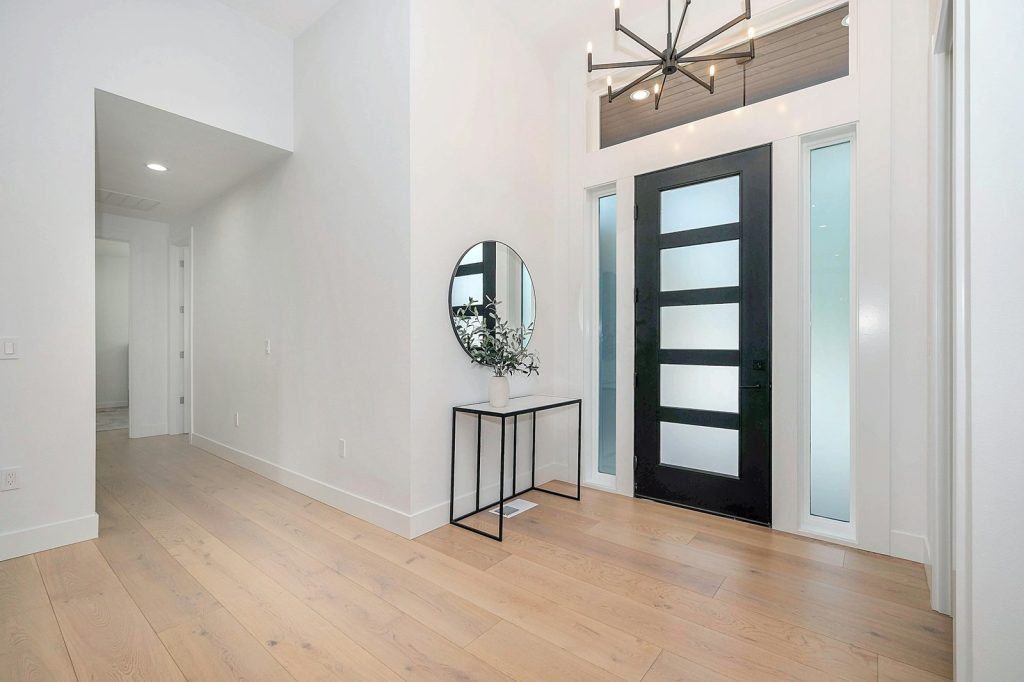
The standard-versus-custom call comes up on almost every glass door project. Standard means whatever the supplier stocks or builds to known sizes. Custom means fabricated specifically for your opening. Both are real options. The right answer depends on the project, not on which sounds more premium.
Here’s how they actually compare.
Lead time
In-stock standard can install within a week or two of confirmation. Custom runs 3 to 5 weeks for residential sizes, longer for unusual configurations.
If the deadline is tight, that’s it, standard is the path. If you’re flexible on timing, the lead-time gap doesn’t really change anything.
Cost
Custom costs 15 to 30 percent more than equivalent standard. The premium covers individual cutting and assembly that mass production skips.
On a tight budget, that 15 to 30 percent can decide whether the project happens. On a comfortable budget, it’s a line item, not an obstacle.
Fit
Custom wins here, cleanly. The doors are made to your actual opening, so the fit is exact. Standard doors fit a defined set of dimensions; if your opening doesn’t match, you’re either modifying the opening or living with a compromise.
New builds can build the opening to fit standard. Renovations usually can’t, the opening is whatever it is, and often the only way to avoid visible gaps is custom.
Look
Most standard glass doors look fine. The systems are mature, the proportions are well-considered, and a well-installed standard door doesn’t look cheap.
Custom can match specific design intent more precisely: unusual proportions, particular panel layouts, specialty glass features. If the architect is being specific about what the door should do visually, that’s when custom delivers.
Without specific design intent, the visible difference between a good standard door and the custom equivalent is usually small enough that nobody but the person who paid for it will notice.
Durability
This one’s interesting because the comparison kind of breaks down. Durability depends on spec, not on whether the door is custom or standard. A premium standard door from a reputable supplier outlasts a cheap custom door from a low-end fabricator, no contest.
Standard product even has a small advantage on parts availability decades out. The system is widely installed, so a replacement roller or hinge in year 20 is usually easy to find. Custom replacement parts sometimes require going back to the original fabricator, which may or may not still exist.
Where each one wins
Standard tends to be the right call when the opening matches standard dimensions, the timing is tight, the budget is constrained, or the design intent is general.
Custom tends to be the right call when the opening doesn’t match a standard size and the wall can’t easily be modified, when the design needs specific proportions or features, when the budget allows for it, or when the timeline is flexible.
One thing worth knowing: if your opening is within a few inches of standard, modifying it to match is often cheaper than paying the custom premium. Run the math before assuming you need custom.
The third path
There’s a middle option that comes up on a lot of Jamaican projects: standard product with custom finish. The frame and glass dimensions are stock, but the finish (frame colour, glass spec, hardware grade) is selected to coordinate with the design.
Lead time stays close to standard. Cost stays close to standard. The visual result coordinates without paying the full custom premium. For projects with standard openings but specific aesthetic requirements, this often delivers what looks like custom at much less than custom cost.
Related reading
- Custom vs standard glass doors: which fits your home?
- What does a glass door installation cost in Jamaica?
- What size glass door fits your space?
For background on glass fabrication as a manufacturing process, Wikipedia covers the underlying industry.
Frequently asked questions
How much more does custom glass door fabrication cost than standard?
Typically 15 to 30 percent more for comparable doors. Custom fabrication loses the scale economies of standard production: every cut, every assembly step is individual rather than batched. For modest custom changes (size adjustment for an existing opening), the premium is at the lower end. For substantially unusual configurations, it’s higher.
How long does custom glass door fabrication take?
Typically 3 to 5 weeks for standard residential sizes after confirmation, longer for unusual configurations or oversized panels. Standard product, when in stock, installs within 1 to 2 weeks. The lead time difference is one of the bigger practical considerations on time-sensitive projects.
Are custom glass doors better quality than standard?
Not inherently. Quality depends on the spec (glass grade, frame profile, hardware) rather than custom-versus-standard. A premium standard door from a reputable supplier is higher quality than a cheap custom door from a low-end fabricator. The custom-versus-standard decision is about fit and design intent, not quality.
Can I get a standard glass door modified to fit a slightly different opening?
Sometimes, yes. Small modifications (trim adjustments, custom interior finish, different hardware) can be applied to a standard door at modest additional cost. Larger modifications (substantial size change, different panel configuration) usually mean going custom. A supplier can confirm what modifications are practical for a specific product line.
When should I default to custom rather than standard glass doors?
When the opening doesn’t match any standard size and can’t easily be modified, when the design intent requires specific proportions or features that standard doesn’t support, or when the budget specifically allows for the premium. For most other situations, standard is the cost-effective choice, particularly on time-sensitive projects.
The next step
For a quote that prices both options (where the opening could go either way), the quote request form takes the brief and we come back with the standard and custom paths side by side so you can see the cost and lead-time difference clearly.
The glass doors service page covers what we install. The contact page is for questions before the formal quote.
Standard versus custom isn’t a quality decision. It’s a fit and timing decision. Pick the path that matches the project, not the path that sounds more premium.